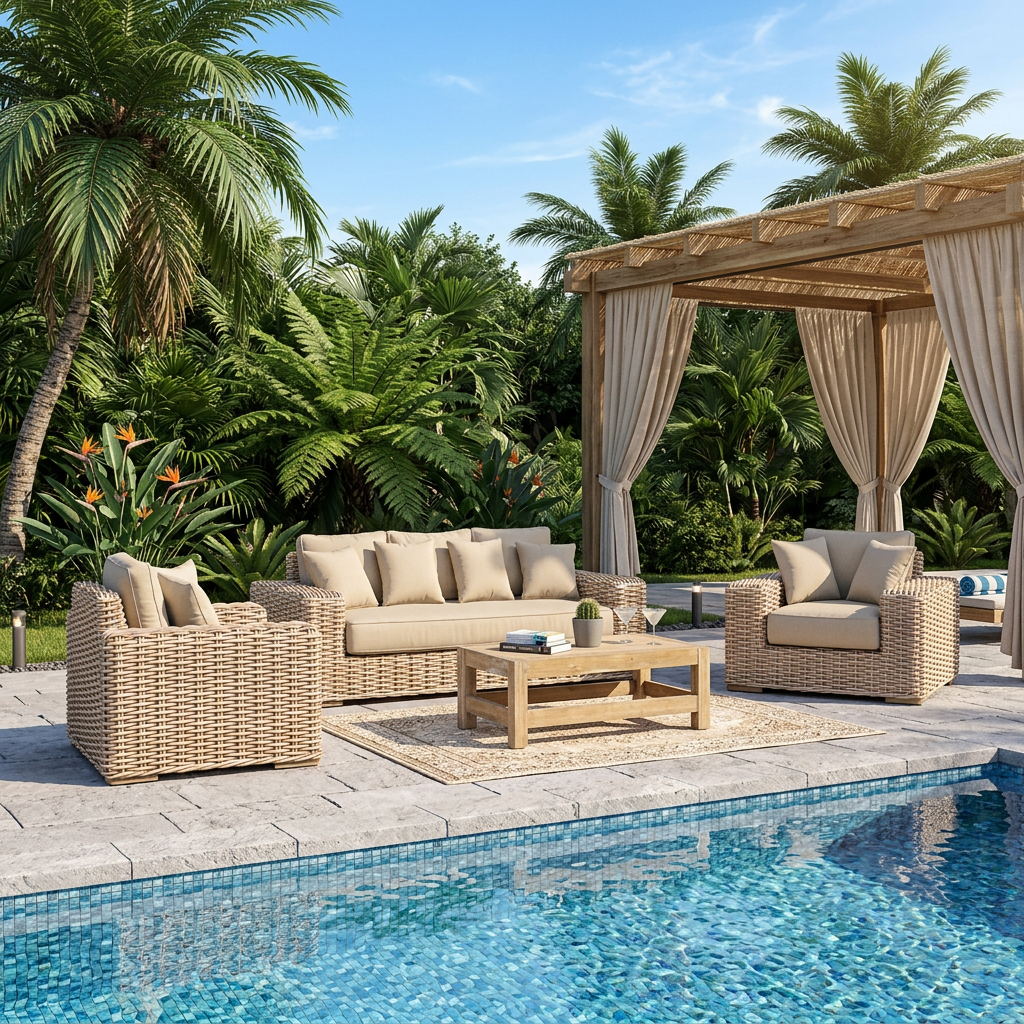
Choosing the right outdoor coffee table size can make your sectional more comfortable and functional. A table that's too large can make the seating area feel crowded, while one that's too small may leave guests reaching for a place to set their drinks.
As a general guideline, an outdoor coffee table should measure approximately half to two-thirds the length of your sectional's main seating run, with about 14–18 inches of space between the table and surrounding seating. The tabletop should also sit near the height of your seat cushions or slightly below.
However, the best fit depends on your sectional's configuration, available patio space, and how you use your outdoor seating area.

What Size Coffee Table Works Best With an Outdoor Sectional?
When choosing an outdoor coffee table, consider four measurements: length, width, height, and clearance from the surrounding furniture.
Each affects how well the table fits within your sectional arrangement.
| Measurement | Recommended starting point |
|---|---|
| Table length | Approximately ½–⅔ the length of the main seating run |
| Table width/depth | Based on the available space between seating pieces |
| Table height | Near seat-cushion height or 1–2 inches lower |
| Distance from seating | Approximately 14–18 inches |
| Main walking paths | Approximately 30–36 inches where space allows |
These measurements are general planning guidelines. The ideal dimensions may vary depending on the sectional's shape, cushion height, and surrounding furniture.
How Long Should an Outdoor Coffee Table Be?
A common furniture-sizing guideline is to choose a coffee table approximately two-thirds the length of the sofa it faces.
For outdoor sectionals, however, half to two-thirds of the main seating run is often a more practical starting range.
For example, if the main seating section measures 84 inches long:
- Half the length is 42 inches.
- Two-thirds is approximately 56 inches.
That gives you a starting coffee table length of approximately 42–56 inches, provided the table fits comfortably within the sectional's open space.
For L-shaped sectionals, avoid using the total length of both sides combined. Instead, focus on the seating area the table will serve and the space available between the sectional's two sides.
How Tall Should an Outdoor Coffee Table Be?
Your coffee table should generally sit close to the height of your sectional's seat cushions or approximately 1–2 inches lower.
For example, if your sectional has a seat height of 18 inches, a coffee table measuring approximately 16–18 inches high may provide a comfortable fit.
This helps keep drinks, books, and other items within easy reach while seated.
Some outdoor sectionals have lower, lounge-style seating. In those arrangements, a lower coffee table may be more appropriate than a standard-height model.
Before choosing, measure from the patio floor to the top of the seat cushion. Keep in mind that softer cushions may compress when someone sits down, slightly reducing the effective seating height.
How Do You Measure Your Sectional for a Coffee Table?
Getting the right measurements is especially important with sectional furniture because the seating configuration may limit where a coffee table can fit.
Step 1: Measure the Main Seating Area
Start by identifying the main seating run facing the coffee table.
For a straight sectional arrangement, measure the length of that seating section. For an L-shaped sectional, focus on the usable seating area rather than combining the measurements of both sides.
Use the half-to-two-thirds guideline to establish a reasonable starting table length.
Step 2: Measure the Available Space Inside the Sectional
Next, measure the open floor space where the table will sit.
For an L-shaped sectional, check the distance between the seating edges on both sides.
This is important because a table may have an appropriate length but still be too wide for the available space.
If you have a sectional with a chaise extension, measure the distance between the chaise and the main seating area to make sure the table won't obstruct legroom.
Step 3: Allow Room Between the Table and Seating
Plan for approximately 14–18 inches between the coffee table and the front edge of the sectional's seat cushions.
This provides space for seated guests to move their legs while keeping the table within comfortable reach.
If your sectional has seating on two or three sides, check the clearance from each seating position rather than measuring only one side.
For narrow arrangements, a slimmer rectangular table or smaller round table may help maintain comfortable spacing.
Step 4: Check the Walking Paths
Finally, consider how people will move around the seating area.
Where possible, allow approximately 30–36 inches for main walking paths.
This is especially important when your sectional sits near patio doors, steps, railings, or other outdoor furniture.

Example: Measuring an L-Shaped Outdoor Sectional
Suppose your L-shaped sectional has a main seating run measuring 84 inches, with 66 inches of open space available for a coffee table and seating clearance.
Based on the seating length, you might initially consider a coffee table measuring 42–56 inches long.
However, you'll also need to account for clearance on both sides.
With 16 inches of space between the table and each seating edge:
66" − 16" − 16" = 34 inches
That means a table approximately 34 inches wide or narrower would be a reasonable starting point. A 36-inch-wide coffee table would be slightly too large if you want to maintain 16 inches of clearance on both sides.
You would then check the available length, sectional shape, and remaining walkways before selecting the final dimensions.
The takeaway is simple: measure the space around the coffee table, not just the sectional itself.
Which Coffee Table Shape Works Best With a Sectional?
The shape of your outdoor coffee table can influence how easily guests reach it and move around the seating area.
While rectangular tables are a common choice for sectionals, square and round designs can also work well depending on the layout.
Rectangular Coffee Tables: Best for Longer Sectionals
Rectangular coffee tables are particularly practical for larger outdoor sectionals with an extended main seating area.
Their elongated shape provides useful surface space for drinks, serving trays, and other entertaining essentials without requiring excessive depth.
Additional advantages of rectangular coffee tables:
- Narrower designs can help preserve legroom in compact sectional arrangements.
- An elongated tabletop can be accessible from several seating positions.
The main consideration is making sure the table doesn't extend too far toward the sectional's ends or obstruct the open side of the seating area.
Square Coffee Tables: Best for Balanced L-Shaped Layouts
Square coffee tables work well when the open space within an L-shaped sectional has similar dimensions in both directions.
Their balanced proportions can create a natural centerpiece, particularly when seating wraps around two sides.
Additional advantages of square coffee tables:
- A convenient shared surface for drinks and serving trays.
- Similar reach distances from seating positioned along two sides.
However, larger square tables can make narrower sectional configurations feel crowded.
Check the clearance on both seating sides before choosing a square design.
Round Coffee Tables: Best for Easier Movement
Round coffee tables can be a practical alternative when you want a softer furniture arrangement or need to move around the seating area frequently.
Without sharp corners, they can make circulation more comfortable in tighter spaces.
They also work well with curved sectionals or outdoor seating arrangements that include additional lounge chairs.
The main limitation is tabletop space. A smaller round table may offer less usable surface area than a rectangular table serving the same number of seats.
For larger sectionals, consider whether everyone can comfortably reach the table.
Outdoor Coffee Table Examples for Different Sectionals
To see how these dimensions work with actual furniture, consider two coffee table styles and an example of a sectional set with a coordinating table.
South Sea Rattan Mayfair Rectangular Outdoor Coffee Table
The South Sea Rattan Mayfair Wicker Outdoor Coffee Table measures 42" W × 24" D × 18" H, making it a practical example of a rectangular table for outdoor sectional seating.
Its elongated proportions provide usable tabletop space while maintaining a relatively narrow depth, which can be helpful when you need to preserve legroom around your sectional.
The table features handwoven all-weather synthetic wicker over a welded aluminum frame, along with a glass top that provides a smooth surface for drinks and serving trays.
For homeowners with longer seating arrangements, its rectangular design offers a balanced combination of surface area and accessibility.

South Sea Rattan Del Ray Square Outdoor Coffee Table
The South Sea Rattan Del Ray Resin Wicker Square Coffee Table measures 36" W × 36" L × 18" H.
Its square proportions make it worth considering for L-shaped sectionals with a relatively balanced open seating area.
The table features a powder-coated aluminum frame wrapped in weather-resistant resin wicker, with a tempered glass tabletop.
At 36 inches wide, it provides a generous central surface, although you'll want to confirm that the sectional leaves enough room on both sides for comfortable seating and movement.

What About Sectional Sets That Already Include a Coffee Table?
If you're purchasing a complete outdoor sectional set, the manufacturer may already include a coffee table sized to complement the seating configuration.
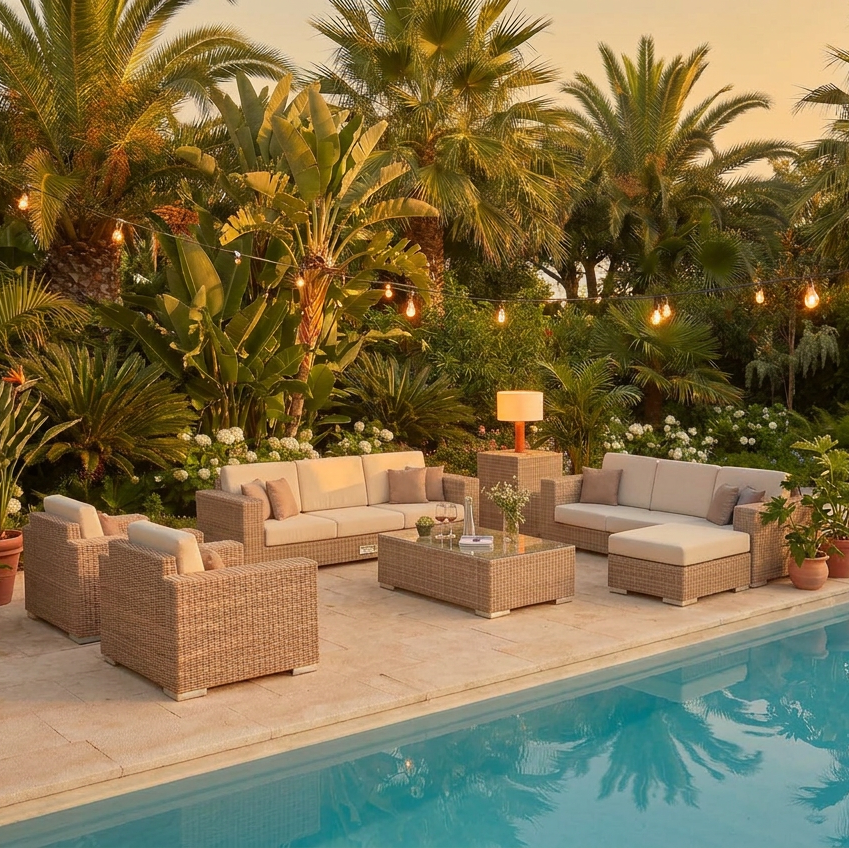
For example, the South Sea Rattan Grand Isle Outdoor Sectional Living Set includes a rectangular coffee table measuring 48" × 24" × 18".
This is a useful example of how manufacturers pair a coffee table with a coordinated sectional arrangement.
If you already own a sectional from a particular collection, checking whether a matching coffee table is available can simplify the selection process.

Bottom Line
The right outdoor coffee table size depends on your sectional's proportions, seating height, and available space.
As a starting point, choose a table approximately half to two-thirds the length of your main seating run, with a height near your seat cushions and around 14–18 inches of clearance from surrounding seating.
For L-shaped sectionals, measure the open space carefully before deciding on a rectangular, square, or round design.
When you're ready to compare options, browse our outdoor coffee tables to find a size and style that complements your sectional.